SpectreDynamics
Technology

How the field system connects.

Three parts work together: field equipment gathers information, a network carries it, and applications help the team use it. Start with the information you need to share. We also design and develop custom hardware for UAS, UGV and USV, from electronic circuits and PCBs to system prototypes.

Understand the system in three parts.

Choose the equipment for the task, define a suitable connection, then decide where the team will view the information. The products below have different roles in that plan.

  1. 01

    Field equipment

    Phones, radios, UAV and sensors provide positions, status or video. Select the platform and visual equipment for your task.

  2. 02

    The connection

    Define how the data reaches the team: an IP network, a compatible radio gateway, or a private LTE/5G network. Meridian Private LTE/5G is available for order, with specifications selected for the project.

  3. 03

    Maps and screens

    SpectreTAK brings team positions and map information together. SpectreCast brings received Analog FPV video onto a computer for viewing, recording or configured streaming.

Follow the information, step by step.

These examples explain two connection paths. Device support and configuration determine which information can travel along each path.

Team positions and shared maps

Bring supported TAK clients and mesh participants into the coordination workflow.

  1. 01Team device or supported mesh radio
  2. 02Configured network connection or gateway
  3. 03SpectreTAK and supported clients

The web console shows maps, devices and network status. Messaging uses supported clients. Each radio network has its own connection path.

Read the TAK and mesh guide
Received Analog FPV video

Bring the video from a compatible receiver onto a computer.

  1. 01Analog FPV receiver
  2. 02Compatible capture device
  3. 03OBS Studio through SpectreCast

Viewing, recording and streaming are configured choices. An optional video distribution service such as MediaMTX is configured separately.

Read the Analog FPV video guide
FPV CONTROL LINK

FPV control links designed for EW resilience.

Spectre Dynamics designs FPV control links for resilience in Electronic Warfare (EW) environments. The system supports continual updates to adapt to new detection systems and jammers, with improvements aimed at reducing detectability and the impact of interference.

  • Resilience in contested environments

    Designed to help maintain the control connection in operating environments affected by electronic interference.

  • Adapt to evolving threats

    Ongoing improvements aim to reduce detectability and disruption as detector and jammer systems evolve.

  • Continual system updates

    Supported control link equipment can receive updates to improve its response to new detection and jamming threats.

Equipment selection and update scope are defined for the project, with performance evaluated against the intended operating conditions.

CUSTOM HARDWARE / UNMANNED SYSTEMS

Hardware built around your unmanned system.

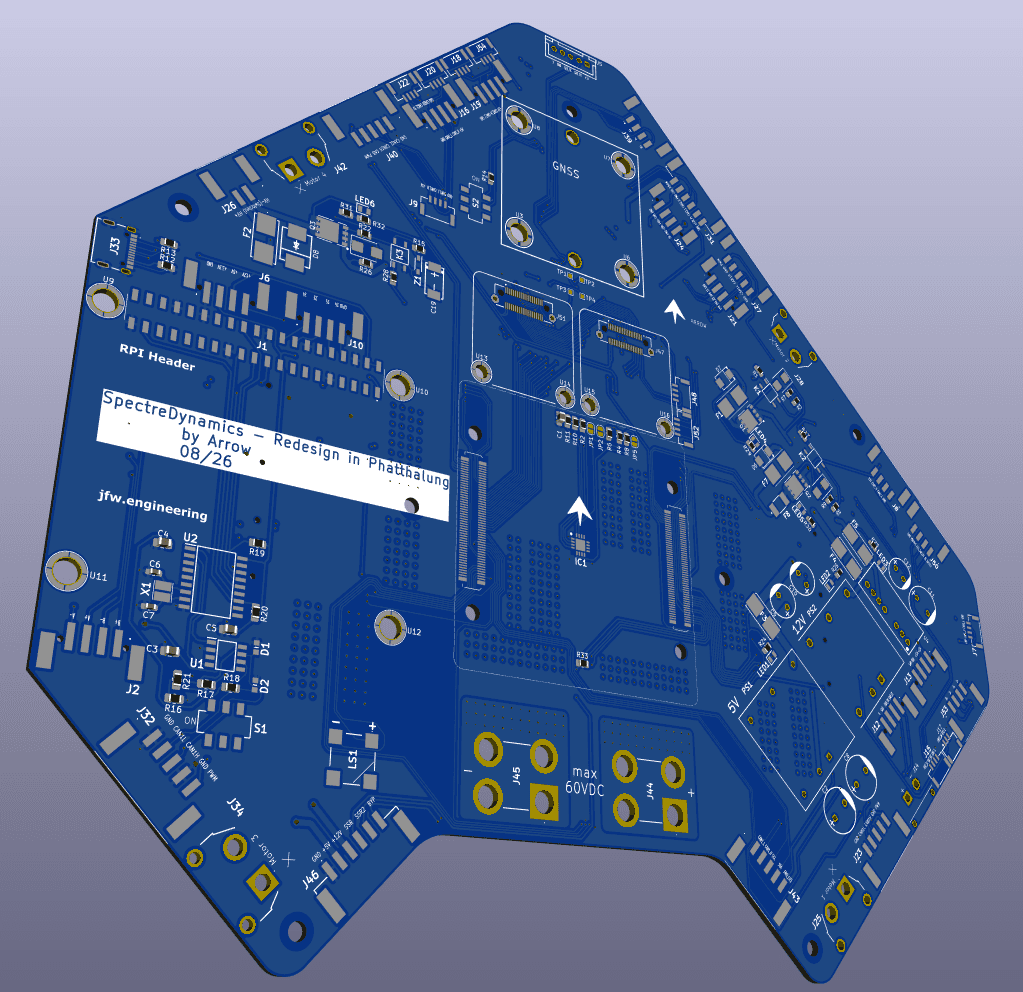
We design and develop hardware for UAS, UGV and USV: electronic circuits, custom PCBs and prototype systems built around the platform, its interfaces and the equipment your project needs.

Blue Spectre Dynamics custom PCB rendering showing board traces, connectors and component footprints
Spectre Dynamics · custom PCB design
UAS

Unmanned Aircraft Systems

Hardware for airborne platforms and their ground equipment.

UGV

Unmanned Ground Vehicles

Electronics and interfaces for unmanned ground platforms.

USV

Unmanned Surface Vehicles

Hardware for unmanned surface platforms and onboard equipment.

From circuit design to a system prototype.

  • Electronic circuit and PCB design
  • Power, sensor and communication interfaces
  • Embedded hardware and firmware integration
  • Prototype development and project-specific testing

The development scope, interfaces, operating conditions and deliverables are agreed for each project.

Discuss your hardware project

CUSTOM SOFTWARE · FULL STACK · DUAL-USE

FPV UAS Software Development

Our Phatthalung and Trang teams develop nearly all of the software for our FPV platforms, including customized Betaflight, Reaper Eye integration and Control Link software. Our wider development services cover embedded firmware, communications, Flight Controllers, VTX/VRX, ground stations and custom protocols.

PHATTHALUNG · TRANG · THAILAND

Our software. Developed in our Thailand labs.

Nearly all of the software for our FPV platforms is developed by our own team at the Phatthalung and Trang labs. This includes adapting Betaflight and building the software that connects flight control, onboard systems and ground equipment.

Customized Betaflight

Our team modifies Betaflight to meet military mission requirements and integrates it with the Spectre FPV platform.

Reaper Eye integration

Our platform software supports integration with Reaper Eye visual systems as part of the agreed platform configuration.

Control Link software

We develop Control Link software with reduced detectability by commercially available Drone Detector systems and resilience against jammers and electronic warfare (EW) as design goals.

Control Link performance depends on the selected hardware, software configuration, operating environment and the detection or interference system involved. Evaluation criteria are defined for each project.

  • Communications & telemetry
  • Flight Controller software
  • VTX / VRX software
  • Custom protocols & APIs
  • Ground software & system integration
Meridian Private LTE/5G
Available for order

Private LTE/5G for field connectivity and UAV Control

Meridian Private LTE/5G is a private mobile network for tactical operations and disaster response, available for order. Connect compatible field devices, SpectreTAK, MANET/IP and UAV equipment through the network configured for the project.

  • Connect compatible phones, tablets and gateways
  • Plan MANET/IP and UAV video paths
  • Evaluate two-way UAV control and flight telemetry
UAV control path

Send control commands from the ground station and return flight telemetry over a defined IP path.

  1. Ground control station
  2. Meridian Private LTE/5G
  3. Compatible UAV + gateway + autopilot

Ground station, autopilot, communication equipment, network performance and behaviour on connection loss must be evaluated together before flight use.

More detail when you are planning a system.

Start with the overview above. Open these notes to check the interfaces and compatibility needed for your equipment.

How do the mesh radios reach SpectreTAK?

Meshtastic uses configured MQTT; MeshCore uses Companion TCP or an HTTPS gateway beside the field radio; Reticulum uses configured interfaces and LXMF. The relevant gateway needs an IP path to the server. Each network uses its own protocol and configured connection.

What do device status and telemetry tell the team?

Position, battery and diagnostic information depend on what the client reports. A recent server connection and a recent position update are separate signals; check both when reviewing a device.

Which clients can receive mesh images?

SpectreTAK reduces mesh images to 8 KiB and needs compatible receiving software. Standard Meshtastic and MeshCore phone apps do not reconstruct those image fragments. Evaluate text, position and image support separately with the selected clients.

How are accounts and server updates managed?

TAK clients use configured certificates. Mesh identities are linked to active accounts, and MeshCore gateway credentials can be revoked. Web users can enable authenticator MFA. Live Reticulum status and managed RNS updates with version restore are available in the SpectreTAK console.

Define four things before deployment.

Use the equipment your team will actually operate to agree the connection paths and evaluation scope. Discuss evaluation at our Test Labs in Trang and Phatthalung, where we develop and test eNB and UE. The Core Network is located in Krabi.

  1. 01

    Equipment

    List phones, TAK clients, radios, UAV, receivers, capture devices and ground control stations.

  2. 02

    Information

    Decide whether the team needs positions, messages, images, live video or UAV control and telemetry.

  3. 03

    Operating area

    Define power, available IP connectivity, the number of users and where the system will run.

  4. 04

    Evaluation

    Check compatibility and behaviour with the chosen equipment. For UAV control, include what happens when the connection is lost.

Plan the connections your team needs.

Tell us the task and equipment you have. We will discuss the products, configuration and evaluation that fit the project.

MERIDIAN / NEXT NETWORKS

ACTIVE R&D

The next frontier: 6G Network + AI-RAN.

Meridian connects the field with Private LTE/5G today. Our research explores 6G Network architectures and AI-RAN. We have selected NVIDIA Aerial as a platform for this research and development.

FUTURE NETWORK ARCHITECTURE

6G Network

Research into how future mobile networks could connect communications, distributed computing and field applications. The focus is on architectures that can evolve with new operational needs, with performance and integration to be evaluated through research.

  • Future network architecture
  • Distributed and edge computing
  • Paths from research to prototypes

INTELLIGENT RADIO NETWORKS

AI-RAN

Our AI-RAN research uses NVIDIA Aerial. We study how AI can analyse radio network conditions and inform resource allocation, alongside the integration of RAN infrastructure and AI computing.

  • Radio network analysis with AI
  • Research into adaptive resource allocation
  • RAN and AI computing integration

OUR RESEARCH PLATFORM

From network simulation to system experiments.

We use NVIDIA Aerial for radio processing, AI development and simulation in our 6G and AI-RAN research.

NVIDIA Aerial

Tools and accelerated computing for developing, simulating and evaluating AI-RAN. NVIDIA Aerial provides the research platform for our work on radio networks and AI computing.

Explore Aerial documentation

Our test network

We develop and test eNB and UE at our Test Labs in Trang and Phatthalung. The Core Network is located in Krabi.

  • TrangTest Lab

    eNB and UE development and testing

  • PhatthalungTest Lab

    eNB and UE development and testing

  • KrabiCore Network

    Core Network location

6G Network and AI-RAN are currently in R&D. Private LTE/5G is available for order; research capabilities and release dates have not been announced.

How the field system connects | Spectre Dynamics